Friday, May 4, 2012

Rihanna Breaks VEVO Record With 'Where Have You Been' Music Video

rihanna-breaks-vevo-record-with-where-have-you-been Rihanna is celebrating an unprecedented feat yet again. The Barbados beauty collects 4.9 million views with her music video for latest single "Where Have You Been" in just 24 hours after the clip made its way out on the internet.

By getting almost 5 million views, Riri surpasses Nicki Minaj who previously held the record with her "Stupid Hoe" video. Back then, the female rapper "clocked 4.8 million views, the highest single-video VEVO number in 24 hours ever."

"NUMBERS ARE IN! After filtering out the BS & triple-checking, @Rihanna #WHYBvideo24hrRECORD stands @ 4,937,281! Congrats!" VEVO tweeted. "@Rihanna love this s**t! Congrats to you and the Navi." In response, Riri wrote, "anybody else lovin the way @vevo tweets?"

"Where Have You Been" is the latest single from Riri's sixth studio album "Talk That Talk".

AceShowbiz

Japan switches off last nuclear power plant; will it cope?

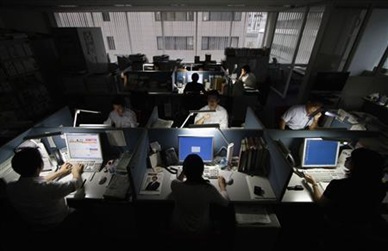
Japan-shuts-down-its-last-working-nuclear-power-reactor Japan shuts down its last working nuclear power reactor this weekend just over a year after a tsunami scarred the nation and if it survives the summer without major electricity shortages, producers fear the plants will stay offline for good.

The shutdown leaves Japan without nuclear power for the first time since 1970 and has put electricity producers on the defensive. Public opposition to nuclear power could become more deeply entrenched if non-nuclear generation proves enough to meet Japan's needs in the peak-demand summer months.

"Can it be the end of nuclear power? It could be," said Andrew DeWit, a professor at Rikkyo University in Tokyo who studies energy policy. "That's one reason why people are fighting it to the death."

Japan managed to get through the summer last year without any blackouts by imposing curbs on use in the immediate aftermath of the earthquake and tsunami. Factories operated at night and during weekends to avoid putting too much stress on the country's power grids. A similar success this year would weaken the argument of proponents of nuclear power.

"They don't have the polls on their side," said DeWit. "Once they go through the summer without reactors, how will they fire them up? They know that, so they will try their darndest but I don't see how."

Japan has 54 nuclear power reactors, including the four at Tokyo Electric's Daiichi plant in Fukushima that were damaged in the earthquake and tsunami, culminating in three meltdowns and radiation leaks for the worst civilian nuclear disaster since Chernobyl in 1986.

One by one the country's nuclear plants have been shut for scheduled maintenance and prevented from restarting because of public concern about their safety.

The last one running, the No3 Tomari reactor of Hokkaido Electric Power Co in northern Japan, is scheduled to shut down early on Sunday. Anti-nuclear activists will celebrate with demonstrations over the weekend.

COSTLY OPTION

The last time Japan went without nuclear power was in May 1970, when the country's only two reactors operating at that time were shut for maintenance, the Federation of Electric Power Companies of Japan says.

Nuclear power provided almost 30 percent of the electricity to keep the $5 trillion economy going before the March 11, 2011 disaster that killed almost 16,000 people and left more than 3,000 missing.

A year on, the level of public concern about the safety of the industry is such that the government is still struggling to come up with a long-term energy policy, a delay having a profound impact on the economy and underlining just how costly it will be to contemplate a nuclear-power-free future.

Having boomed in recent decades on the exports prowess of big brands like Sony, Toyota and Canon, the economy suffered its first trade deficit in more than three decades in 2011 as power producers spent billions of dollars on oil-and-gas imports to fuel extra generation capacity.

At the time of the Fukushima crisis, then Prime Minister Naoto Kan called on Japan to wean itself off of nuclear power. Up to that point, Japan had been planning to lift the share of nuclear generation to over 50 percent by 2030 from about 30 percent.

The government of current Prime Minister Yoshihiko Noda has softened Kan's call. Noda says Japan cannot afford to be nuclear free, although he still holds that as an ideal.

But the government has no clear timetable for getting nuclear power back up and running as it tries to navigate the public opposition -- rare in Japan -- and the demands of business that wants a stable supply of power.

Cabinet ministers last month rushed to try to win over the public to allow the restart of two nuclear power reactors at Kansai Electric Power Co's Ohi plant in western Japan, in what experts said was a recognition of the implications of a nuclear-free summer.

The public remained unconvinced. A poll by Kyodo news agency last weekend showed about 60 percent of the public opposed to restarting the two reactors.

Most mayors and governors whose communities host nuclear plants want safety assurances beyond government-imposed stress tests before agreeing to restarts, a Reuters poll showed in March.

To overcome the opposition, some politicians have been more forceful. Yoshito Sengoku, the acting president of the ruling Democratic Party of Japan, on April 16 called an abandonment of nuclear energy the equivalent of "mass suicide," Kyodo news reported. His comment was criticized by Chief Cabinet Secretary Osamu Fujimura, indicating internal divisions over how to handle the issue.

Trade Minister Yukio Edano - the government's point man for energy policy - walks a fine line, saying both that safety must come first while trying to win the support of local communities for restarts.

Kansai Electric Power Co, the utility most reliant on nuclear power, and some other electricity producers have warned of power shortages this summer but have largely avoided lobbying publicly for restarts for fear of a backlash.

GLOBAL SHIFT

Ultimately, some argue Japan's economy, already weakened by years of deflation, would suffer if reactors are not restarted.

"It's not an option Japan should take. There will be less employment and the economy will be on a shrinking trend," said Takeo Kikkawa, a professor at Hitotsubashi University.

Japan's liquefied natural gas imports climbed 18 percent in volume and 52 percent in value to 5.4 trillion yen ($67 billion) in the year through March.

Renewable energy, although given emphasis in energy policies being formulated, is not expected to be much of an immediate salve. Energy from renewable sources account for about 10 percent of Japan's power generation, most of that from hydroelectric dams. Wind and solar together contribute about 1 percent.

Worldwide, there has been a shift with Germany, Italy and Switzerland moving away from atomic energy, prompting the International Atomic Energy Agency to revise down its forecast for growth in the industry.

The United States, China and India are still planning to increase the number of reactors.

In Japan, a delay in setting up a new, more independent Nuclear Regulatory Agency due to deadlock in a divided parliament is further clouding the outlook.

Some analysts say the government is not going to turn public opinion unless it admits that nuclear power is never going to be absolutely safe.

"The debate needs to be recast," said Bob Geller, a professor of geophysics at Tokyo University. "They have to come clean, and say, in effect - look we know they're not perfectly safe but we've made a careful evaluation of the risks, which we'll make public." ($1=80.165 yen)

(Additional reporting by Yoko Kubota, Linda Sieg, Osamu Tsukimori and Risa Maeda in Tokyo: Editing by Edwina Gibbs and Neil Fullick)
Reuters

New 'Amazing Spider-Man' Trailer Set to Unveil Mystery of Peter Parker's Origin

amazing-spider-man-img01 Just a few days after "The Dark Knight Rises" released its final trailer, another highly anticipated superhero movie, "The Amazing Spider-Man", debuts its own latest promo video. Compared to the previously released trailers, this fresh one puts its focus on Peter Parker's effort to unveil the secret surrounding the disappearance of his parents.

Also highlighted in the video is tons of new fight scenes between Spidey and his archenemy the Lizard, who apparently holds the key to unlock Peter's origin. Additionally, there is a quick glimpse at the scene that shows how the lead protagonist gets his radioactive spider bite that turns him into a superhuman.

Speaking about the radioactive spider that gives Peter a superpower as described in the comic, director Marc Webb gave a little hint that in his movie the story could be different. "He's bitten by a spider, but maybe it's not a radioactive spider. Or maybe it is! You'll have to see," he once told MTV News.

Due to open in the U.S. on July 3, "The Amazing Spider-Man" has Andrew Garfield tackling the part of the titular hero, and Emma Stone starring as his leading lady Gwen Stacy. Also supporting the movie are Rhys Ifans as supervillain Lizard, Denis Leary as Captain Stacy, as well as Martin Sheen and Sally Field as Ben and May Parker.

AceShowbiz

Argentina nationalizes oil company YPF

Argentina-nationalizes-oil-company-YPF Argentina's Congress nationalized the country's biggest oil company, YPF, by an overwhelming lower house vote on Thursday that underscored broad popular support for a measure that threatens to scare off foreign investment.

The Chamber of Deputies voted 207-32 in favor of expropriating YPF, clearing the way for President Cristina Fernandez to sign the bill into law. The Senate last week approved the measure by a similarly overwhelming margin.

Fernandez, who has tightened state control of the economy, unveiled the plan to seize a majority stake in YPF from Spain's Repsol six months after her landslide re-election.

The move drew a swift reprisal from Spain, which curtailed Argentine biodiesel shipments. Wall Street warns that Argentina risks scaring off investment needed to bolster growth against fallout from Europe's debt crisis and slower demand from key trade partner Brazil.

Business groups have long been put off by Fernandez's policies, such as her government's takeover of Argentina's private pension system in 2008 and, more recently, import and foreign exchange controls that have hurt confidence.

Fernandez justifies the renationalization of YPF - which was privatized in the 1990s after decades as a state-owned company - on the grounds that it failed to boost oil and natural gas production needed to keep up with local demand.

Energy import bills have shot higher, putting Argentina's prized trade surplus at risk.

Repsol denies under-investing, but the government's message has struck a chord with Argentines, many of whom are suspicious of foreign companies and blame the free-market policies of the 1990s for setting the country up for its 2001/02 sovereign debt default and shock currency devaluation.

"All oil companies that operate in Argentina, Repsol and the rest, have to work in the public interest, which in this case means energy self sufficiency for Argentina," Agustin Rossi, leader of the official bloc in the lower house, shouted during a speech to the chamber just before the vote.

"Repsol invested little in Argentina," Rossi said. "But it was YPF and Argentine oil that financed Repsol's growth around the world."

With the private sector worried more nationalizations may be on the way, attention now turns to how much Argentina will pay Repsol for control of YPF. Officials have said it will be a lot less than the $9.3 billion the Spanish company wants.

Relieved of much of its debt burden after the 2001/02 default and bolstered by high international soy prices, the grains-exporting powerhouse fared better than many countries in weathering fallout from the 2008 world financial crises.

The government budget predicts 2012 gross domestic product growth of 5.1 percent, down from 8.9 percent last year.

"The goal is for YPF to be aligned with the interests of the country," Fernandez said in a speech on Thursday.

"When corporate interests are not aligned with national interests, when companies are concerned only with profits, that's when economies fail, which is what happened globally in 2008 and what happened to Argentina in 2001," she said.

Citing similar arguments, Bolivian President Evo Morales this week nationalized the local unit of Spain's Red Electrica Espanola, adding to the former colonial power's concerns about investments in the region.

TARNISHED REPUTATION

While most of Fernandez's local critics agree that YPF should be in state hands, some say her confrontational approach could harm the country's already tarnished reputation abroad.

"It's a good move for the country because if the government does not control strategic resources such as oil, it loses power," said financial analyst Leonardo Rodriguez, 32, as he sipped a latté in the well-heeled Buenos Aires neighborhood of Puerto Madero.

"But the approach used in taking over the company, without negotiating, was too jarring and authoritarian," Rodriguez said. "There could be serious consequences. I mean, who wants to invest in a country where the government expropriates private property from one day to the next?"

A gifted public speaker who never appears in public without her trademark mascara and high heels, Fernandez has billed the YPF renationalization as central to her election pledges to deepen the interventionist policies began by her late husband and predecessor as president, Nestor Kirchner.

"The real custodians of his legacy are you," she told supporters at a rally last week in Kirchner's honor. "I know you will never permit a step backward."

(Additional reporting by Helen Popper; Editing by David Gregorio and Ed Davies)
Reuters

Thursday, May 3, 2012

Leaders Threaten Euro 2012 Boycott Over Alleged Ukraine Abuses

A number of European leaders say they plan to boycott the Euro 2012 football tournament next month in Ukraine to protest the alleged mistreatment of the country's former prime minister Yulia Tymoshenko, who is currently in jail.  A new report also raises concerns about the conduct of the Ukrainian police, just as the country prepares for the arrival of soccer fans from across Europe.

May Day brought communist demonstrators onto the streets Tuesday in Kiev - as news of the threatened Euro 2012 boycott spread. Marchers voiced their support for Yulia Tymoshenko and for the boycott - 15-year-old Serhiy was among them.

"It is not right, of course, what they are doing with Yulia Tymoshenko," he said.  "Everybody needs to sort it out, and that she is being defended by the European Union is right."

Photos show former prime minister Yulia Tymoshenko, who is on a hunger strike, with bruises on her arms and stomach that she says were inflicted by prison guards - a charge the government denies.  She is serving a seven-year sentence for abuse of office, charges she says are politically motivated.

The photos prompted several European leaders and ministers, among them the entire Dutch government and the president of the European Commission, to pledge a boycott of next month's Euro 2012 soccer matches in Ukraine.

Germany's Environment Minister Norbert Roettgen urged others to join.

"At the moment I do not think it is feasible for ministers or state prime ministers to take part as visitors [in Euro 2012] because I fear this poses the danger of justification of a regime, a dictatorial regime," said Roettgen.

Other European leaders, including the foreign ministers of Germany and Sweden, have rejected calls for a boycott.

Ukraine analyst Orysia Lutsevych, of the London-based research group Chatham House, says a boycott would hurt all Ukrainians.

"I think there could be better ways around sending a signal and putting pressure on the government other than a boycott," said Lutsevych.  "By having so many journalists in the country and by having so many celebrities in the country we can raise an issue of human rights and democracy in another way."

As Ukraine rushes to complete its new stadiums in time for June, the government hopes Euro 2012 will be a showcase for the country with up to a million visitors expected.

But a new report is raising concerns about the the conduct of the Ukrainian police force.  

Max Tucker of human-rights group Amnesty International points to CCTV footage posted on the Internet, allegedly showing police beating a man in a bar before forcing him to hand over $2,500.  Tucker says the police service needs urgent reform.

"Police are torturing people in order to extract a confession, in order to kind of extort money or simply because of the ethnicity or sexual orientation of the person that they have in custody," said Tucker.

Opinion across Europe appears divided; some argue a Euro 2012 boycott would serve to raise awareness of alleged abuses in Ukraine, while others say the presence of so many foreign journalists and visitors will put a spotlight on the country, perhaps leading to change.

VOA News

 
News Update Users